
Francis Bacon
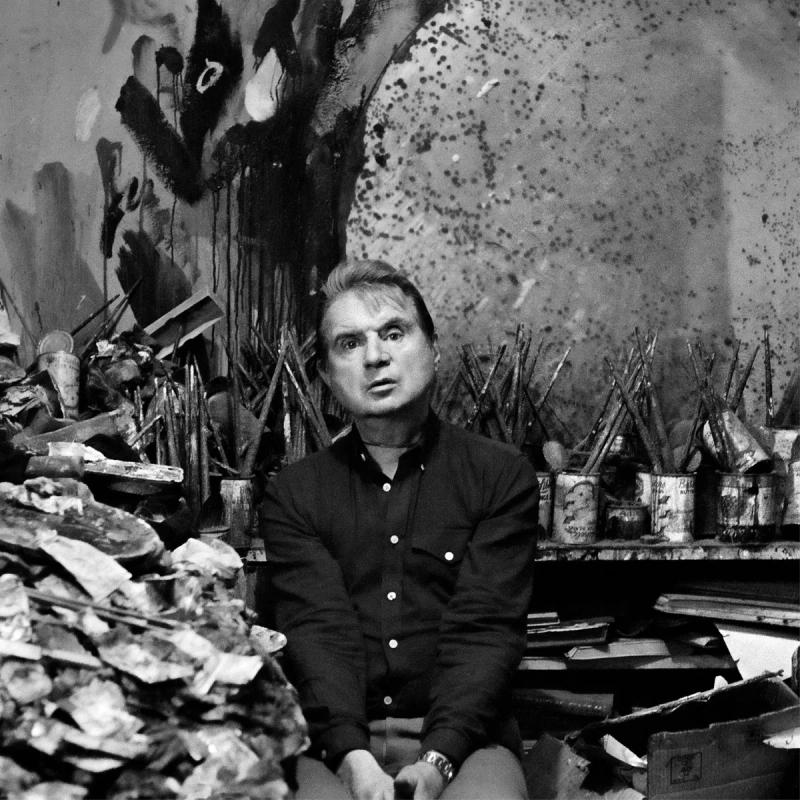
“I would like, in my arbitrary way, to bring one nearer to the actual human being.”
Francis Bacon (1909–1992) painted anguished, distorted, and brutalized figures that reflect postwar angst and existentialism. At a cultural moment dominated by abstraction, the self-taught artist elaborated the Grand Manner tradition in European painting while incorporating, in paint, the visual effects of photography and film. Rather than working from life, he referenced nature photography, reproductions of historical paintings, medical illustrations, movie stills, and pictures of friends, contrasting his human and animal figures with flat, monochromatic grounds or placing them in uncanny airless spaces. Marked by harsh articulation and agitated brushstrokes, his paintings—typically created in sequences or variations on a theme—insist on their materiality, rejecting idealism and transcendence.
Born in Dublin, Ireland, Bacon moved to London at the age of 16. He lived for short stints in Berlin and Paris, where in 1927–28 he attended exhibitions by Pablo Picasso, Giorgio de Chirico, and Chaïm Soutine that inspired him to make drawings and watercolors. His first exhibitions were in London: a group presentation at the Mayor Gallery (1933) and his first solo, at Sunderland House (1934). After a hiatus from painting, in which he worked as an interior decorator and furniture designer, he garnered critical acclaim in 1945 for his triptych, Three Studies for Figures at the Base of a Crucifixion (1944). The Hanover Gallery, London, mounted his first major solo exhibition in 1949, and Durlacher Brothers, New York, held his first solo outside England in 1953. In the 1950s, Bacon’s work variously reconceived Diego Velázquez’s Portrait of Pope Innocent X (1649–50), Vincent van Gogh’s The Painter on the Road to Tarascon (1888), and Eadweard Muybridge’s photographs of humans and animals in motion. He painted nudes, exploring homosexuality and sexual struggle, as well as animals and sphinxes, inspired by trips to South Africa and Egypt. That decade, he also embarked on his first portraits, which would become a focus in the following decades. In 1954, his work featured in the British Pavilion at the Venice Biennale. Bacon’s first retrospective was held at the Institute of Contemporary Arts, London, in 1955. Subsequent traveling retrospectives dedicated to his work have been organized by Tate Gallery, London (1962, 1985, 2008); Solomon R. Guggenheim Museum, New York (1963); Grand Palais, Paris (1971); Hirshhorn Museum and Sculpture Garden, Washington, DC (1989); Musée National d’Art Moderne, Paris (1996); and Yale Center for British Art, New Haven (1999); among numerous other major exhibitions worldwide.
Exhibitions
- Bacon / de Kooning
- Lévy Gorvy Dayan, New York
November 4 - December 19, 2026 Lévy Gorvy Dayan is delighted to announce Bacon / de Kooning opening on November 4, 2026, at 19 East 64th Street, New York. Taking place in the gallery’s 1932 Beaux-Arts townhouse, the exhibition will juxtapose the works of Francis Bacon and Willem de Kooning, two indelible figures of postwar art.
Read More
The presentation will focus on their smaller-scale paintings of the late 1960s and 1970s—de Kooning at primarily 60 by 55 inches, and Bacon at his preferred 14 by 12 inches—each chosen by the artists for their deliberately human proportions. Through these canvas dimensions, b...
